Posts
Feynman diagrams without any physics
A tale from elementary probability theory
Feynman diagrams are associated with complicated physics, but they can also be found hiding in relatively simple questions about Gaussian random variables.
For example, suppose I asked you to calculate the expectation value
where each is a (not necessarily independent) normal random variable with zero mean. Say I want the answer in terms of the covariances between the variables.
Read moreLayout algorithms for flexigrids
This post is a development journal entry for the fletcher package for Typst. Fletcher is a diagramming package that lets users place nodes (content) on a flexigrid (a special coordinate system).
Flexigrids are a cross between a table layout and a coordinate grid. Like tables, the rows and columns grow automatically to account for the size of nodes, but unlike tables, flexigrids also allow fractional coordinates (so a node can be at column $2.5$, for example).
Read moreFrench verb conjugations quizzer
Practice conjugating French verbs in specific tenses and moods. By changing the menus and toggles, you can practice conjugating verbs, distinguishing tenses by how they sound or are written, or even your pronunciation.
Fullscreen version, source code
Read moreBasic general relativity with Julia
Four years after I took general relativity, my professor asked me to send him an old animation I had made during his course showing parallel transport of vectors around a line of latitude on the sphere. Actually, I wasn’t the one who had made it (though I was flattered that he had thought so!)
The tool I reached for was Julia. To my delight, the whole thing was rather simple to make. This was the humble result:
Read moreDefining Entropy with a Composition Law
The mathematical definition of entropy is often hard to motivate, coming across as rather mysterious. But it can be uniquely characterised with a very natural and pretty ‘composition law’, which anyone could come up with.
Theorem: The formula for information entropy
$$ H(𝒑) = -K \sum_{i} p_i \log_2 p_i $$is the unique real-valued function of a finite probability distribution $𝒑$ which:
- is continuous with respect to $𝒑$,
- obeys the Composition Law,
- increases for uniform distributions $𝒑 = (\frac1n, ..., \frac1n)$ as the width $n$ increases,
- has some fixed value $K$ for a fair coin toss $𝒑 = (\frac12, \frac12)$.
The last assumption is merely a choice of units — without it, the function is defined up to an overall scaling factor.
Read moreDaylight Hours: A spherical geometry problem
How many hours are there between sunrise and sunset? The Earth’s tilt makes this a fun geometry problem…
Hours of daylight at the solstice
Let $ε$ be the Earth’s tilt, or obliquity. This is the angle between Earth’s axis of rotation $N$ and the normal to Earth’s orbital plane around the sun, $O$. At first, let’s assume that the Earth tilts directly toward the sun (or directly away, for $ε < 0$). This direct alignment occurs twice a year, at the summer and winder solstices. We can consider seasons later; for now, assume we’re at summer solstice.
Read moreBilliard geometry: Visually solving elastic collisions
Suppose two bodies with initial momentum vectors $𝒑_1$ and $𝒑_2$ collide, so that the final momenta are $𝒑_1'$ and $𝒑'_2$.
If no restrictions are placed on these four momentum vectors, then we can describe all kinds of collisions, including ones that violate momentum and energy conservation.
Read moreGeometric Algebra for Special Relativity and Manifold Geometry · PDF
My master’s thesis in mathematical physics completed in March 2022 at Victoria University of Wellington.
The thesis centres around geometric algebra and its applications to special relativity.
Table of Contents
I. Geometric Algebra and Special Relativity
- Introduction
- Preliminary Theory
- Associative Algebras
- The Wedge Product: Multivectors
- The Metric: Length and Angle
- The Geometric Algebra
- Construction and Overview
- Relations to Other Algebras
- Rotors and the Associated Lie Groups
- Higher Notions of Orthogonality
- More Graded Products
- The Algebra of Spacetime
- The Space/Time Split
- The Invariant Bivector Decomposition
- Lorentz Conjugacy Classes
- Composition of Rotors in terms of their Generators
- A Geometric BCHD Formula
- BCHD Composition in Spacetime
- Calculus in Flat Geometries
- Differentiation of Fields
- Case Study: Maxwell’s Equations
II. Geometric Algebra and Special Relativity
Read moreWorld Flags Quizzer
Learn world flags by getting quizzed!
Flags are chosen randomly weighted by the country’s population.
Press Check or type enter to submit your answer, and type ? to show the flag’s country name.
Flags you get right in one try are “memorized” and won’t be shown again.
A Simple Example of a Connection With Torsion
While learning general relativity as an undergrad, I was uneasy with the idea of torsion of an affine connection. Familiar phrases like “torsion measures how a frame twists as it undergoes parallel transport” seemed too lofty to serve as a helpful mental model.
The following example is one which gave me an aha! moment.
A “rolling” connection on $ℝ^2$.
Consider a connection on the plane defined in such a way that a vector undergoing parallel transport rotates in the $xy$-plane in proportion to its motion along the $x$-direction. That is, define a connection so that the vector field defined by
Read moreTimeline of Scientists
This is an interactive timeline of famous mathematicians and physicists throughout history. The data is pulled from Wikidata.
Showing scientists, in decreasing order of number of Wikidata entities named after them. Hold `alt` and scroll to zoom.
Explicit Baker–Campbell–Hausdorff–Dynkin formula for Spacetime via Geometric Algebra · arχiv
In brief. In $≤4$ dimensions, there’s a simple formula for the bivector $σ_3$ in terms of bivectors $σ_1$ and $σ_2$ such that $e^{σ_1}e^{σ_2} = ±e^{σ_3}$.
Abstract. We present a compact Baker–Campbell–Hausdorff–Dynkin formula for the composition of Lorentz transformations $e^{σ_i}$ in the spin representation (a.k.a. Lorentz rotors) in terms of their generators $σ_i$:
$$ \ln(e^{σ_1}e^{σ_2}) = \tanh^{-1}\qty(\frac{ \tanh σ_1 + \tanh σ_2 + \frac12\qty[\tanh σ_1, \tanh σ_2] }{ 1 + \frac12\qty{\tanh σ_1, \tanh σ_2} }) $$This formula is general to geometric algebras (a.k.a. real Clifford algebras) of dimension $≤ 4$, naturally generalising Rodrigues’ formula for rotations in $ℝ^3$. In particular, it applies to Lorentz rotors within the framework of Hestenes’ spacetime algebra, and provides an efficient method for composing Lorentz generators. Computer implementations are possible with a complex $2×2$ matrix representation realised by the Pauli spin matrices. The formula is applied to the composition of relativistic $3$-velocities yielding simple expressions for the resulting boost and the concomitant Wigner angle.
Read moreMathematical One-liners
This is a collection of succinct but wonderfully satisfying theorems. Leave a comment if you have a good one!
Read moreLight installation for Gatherings Restaurant
A projected light show made for a multi-sensory dining experience at Gatherings restaurant.
Interactive fullscreen version.
Act 0: Arrival
Pet nat // sparkling white wine, honey, fielding, clover, shoreline, waipara champagne, popping.
Canapes, kina w potato, ricotta and seaweed tart // refined, interesting, saline, creamy green.
An Overview of the Strong CP Problem and Axion Cosmology · PDF
Literature review supervised by Dr. Jenni Adams at the University of Canterbury.
I wanted to learn more about particle physics after my Bachelor’s, so a year of part-time study culminated in this literature review. I learned basic classical (and a little quantum) field theory, and read about the “strong $CP$ problem” of quantum chromodynamics and its solution via “axions”. The report is aimed at the mathematically-inclined graduate who is uninitiated in particle physics.
Read moreThe Many Faces of Stokes’ Theorem
{% assign project_url = site.github.url | append: “/projects/stokes-theorem” %}
The generalised Stokes theorem has the remarkably compact form
$$ \boxed{ \int_Ω \dd ω = \int_{∂Ω} ω } $$where $Ω$ is a $k$-dimensional manifold with boundary $∂Ω$, and $ω$ is a $(k - 1)$-form on $Ω$.
While it may seem alien at first when expressed in full generality, you may recognise some of the many special cases of Stokes’ theorem, especially from vector calculus.
Read moreAsymptotic Structure and Symmetries of FLRW Universes · PDF
Honours project supervised by Prof. David Wiltshire at the University of Canterbury.
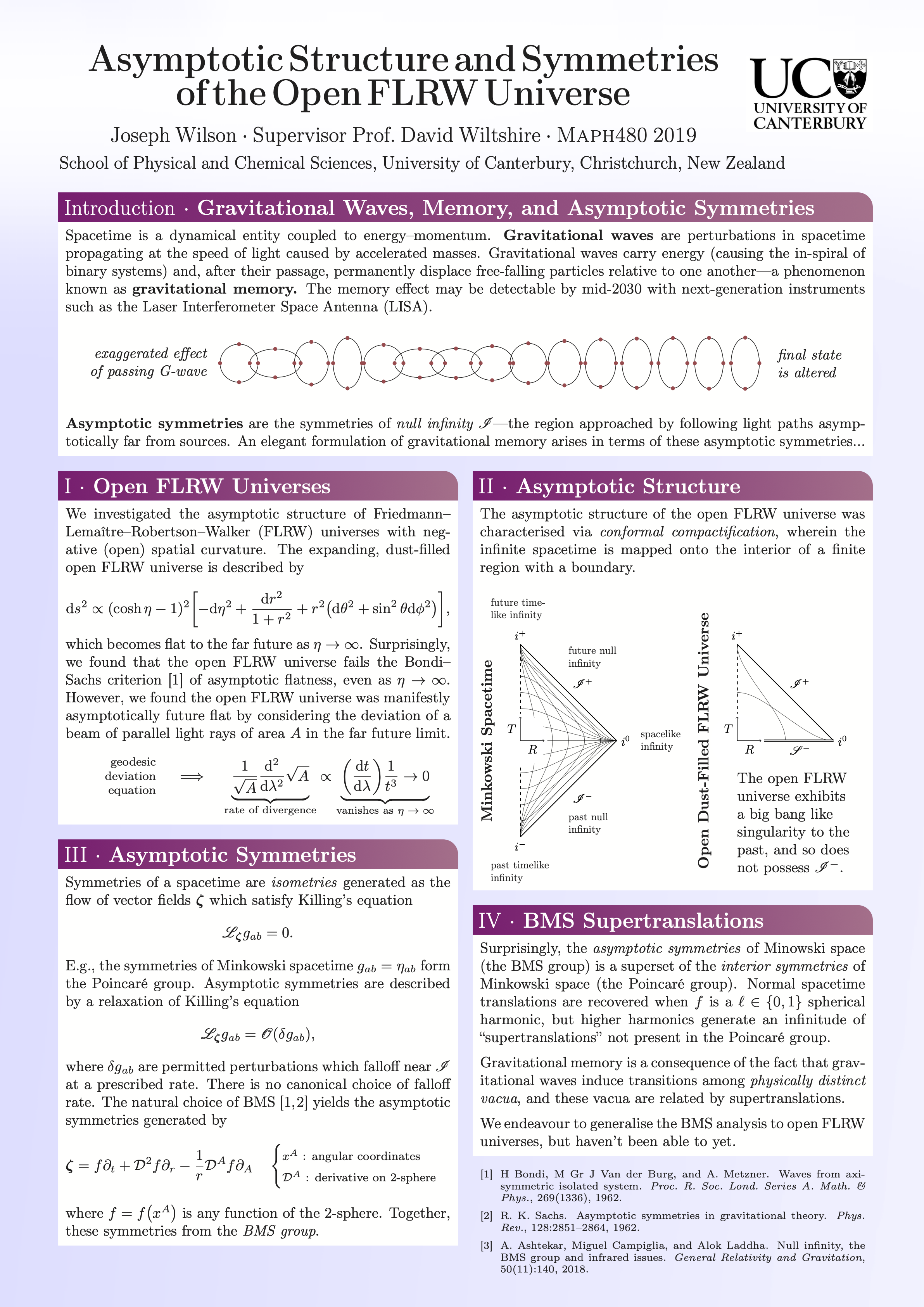
There is a fascinating relationship between the asymptotic symmetries of spacetime and gravitational waves and memory, sometimes referred to as The Infrared Triangle. We investigated the asymptotic structures of simple cosmological spacetimes, extending the usual analysis for flat spacetime.
You can find the full report (PDF) and also the poster (PDF).
Computing Crystal Band Structures with CP2K · PDF
Summer project about the theory behind numerical computation of the semiconductor band structure of crystals using the open source software CP2K. Full PDF.
Read moreVan Gogh's Starry Night as a phase portrait
The Dynamical Systems course I took had a competition to invent a dynamical system with the most creative phase portrait.
Here’s my entry: the Starry Night system.
# Scalar part
s := (-2*(y/2 - 1)^2 + θ((x - 4.63)^2 + (y - 167/50)^2 - 1/25)*θ(-(x - 91/20)^2 - (y - 82/25)^2 + 49/625) - 3*θ(x/50 - y + sin(15*x + 1)/10 + 22/25)/10 - 4*θ(2*x/25 - y + 117*sin(29*x/5 + 1.3)/1000 + 49/50)/5 + 4*θ(19*x/100 - y + 31*sin(17*x/5 + 84/25)/200 + .77)/5 + 5/2 + 27*exp(-(100*(x - .19)^2 + 100*(y - 43/20)^2)^2)/10 + 3*exp(-(100*(x - 1/2)^2/7 + 100*(y - 19/5)^2/7)^2) + 27*exp(-(500*(x - 31/50)^2/11 + 500*(y - 2.07)^2/11)^2)/10 + 2*exp(-(50*(x - 57/50)^2 + 50*(y - 191/50)^2)^2) + 4*exp(-(20*(x - 29/25)^2 + 20*(y - 82/25)^2)^2) + 3*exp(-(50*(x - 8/5)^2 + 50*(y - 67/25)^2)^2) + 3*exp(-(200*(x - 1.69)^2/7 + 200*(y - 19/5)^2/7)^2)/2 + 2*exp(-(25*(x - 1.73)^2/3 + 25*(y - 1.9)^2/3)^2) + 3*exp(-(250*(x - 2)^2/3 + 250*(y - 93/25)^2/3)^2) + exp(-(5*(x - 5/2)^2/3 + 5*(y - 13/5)^2/3)^2) + 2*exp(-(250*(x - 76/25)^2/11 + 250*(y - 3.63)^2/11)^2) + exp(-(20*(x - 69/20)^2/3 + 20*(y - 2.1)^2/3)^2) + 2*exp(-(250*(x - 3.51)^2/11 + 250*(y - 76/25)^2/11)^2) + 27*exp(-(5*(x - 91/20)^2/2 + 5*(y - 169/50)^2/2)^2)/10)*θ(y + 7*abs(-x + 17*y*sin(13*y/5 + 4.33)/250 + .91) - 2.7)*θ(y + 10*abs(x + (-17*y/250 + 21/125)*sin(5*y/2 + 1.7) - 29/25) - 47/20)*θ(y + 10*abs(x + (-17*y/250 + 21/125)*sin(31*y/5 - 12/5) - 37/40) - 73/20)*θ(y + 121*abs(x + (-17*y/250 + 21/125)*sin(157*y/25 + 24/5) - 1.49)/50 - 1.63)*θ(y + 64*abs(x + (-17*y/250 + 21/125)*sin(79*y/10 + 3) - 2)/25 - .97)

# Vector part, x-component
v_x := (((((y - 82/25)*θ(-(x - 91/20)^2 - (y - 82/25)^2 + 2/5) + ((y - 43/20)*θ(-(x - .19)^2 - (y - 43/20)^2 + .01) + ((y - 2.07)*θ(-(x - 31/50)^2 - (y - 2.07)^2 + 11/500) + ((y - 76/25)*θ(-(x - 3.51)^2 - (y - 76/25)^2 + 11/250) + ((y - 3.63)*θ(-(x - 76/25)^2 - (y - 3.63)^2 + 11/250) + ((y - 93/25)*θ(-(x - 2)^2 - (y - 93/25)^2 + 3/250) + ((y - 19/5)*θ(-(x - 1.69)^2 - (y - 19/5)^2 + 7/200) + ((y - 191/50)*θ(-(x - 57/50)^2 - (y - 191/50)^2 + 1/50) + ((y - 19/5)*θ(-(x - 1/2)^2 - (y - 19/5)^2 + .07) + ((y - 82/25)*θ(-(x - 29/25)^2 - (y - 82/25)^2 + 1/20) + ((y - 67/25)*θ(-(x - 8/5)^2 - (y - 67/25)^2 + 1/50) + ((y - 1.9)*θ(-(x - 1.73)^2 - (y - 1.9)^2 + 3/25) + (-θ(-(x - 1.73)^2 - (y - 1.9)^2 + 3/25) + 1)*((2*x/5 - y + 77/25)/((x - .3)^2/4 + (y - 16/5)^2/4)^3 + (-2*x/5 + y - 41/25)/((x - 12/5)^2/4 + (y - 13/5)^2/4)^3 + (2*x/5 - y + 37/50)/((x - 17/5)^2 + (y - 2.1)^2)^3))*(-θ(-(x - 8/5)^2 - (y - 67/25)^2 + 1/50) + 1))*(-θ(-(x - 29/25)^2 - (y - 82/25)^2 + 1/20) + 1))*(-θ(-(x - 1/2)^2 - (y - 19/5)^2 + .07) + 1))*(-θ(-(x - 57/50)^2 - (y - 191/50)^2 + 1/50) + 1))*(-θ(-(x - 1.69)^2 - (y - 19/5)^2 + 7/200) + 1))*(-θ(-(x - 2)^2 - (y - 93/25)^2 + 3/250) + 1))*(-θ(-(x - 76/25)^2 - (y - 3.63)^2 + 11/250) + 1))*(-θ(-(x - 3.51)^2 - (y - 76/25)^2 + 11/250) + 1))*(-θ(-(x - 31/50)^2 - (y - 2.07)^2 + 11/500) + 1))*(-θ(-(x - .19)^2 - (y - 43/20)^2 + .01) + 1))*(-θ(-(x - 91/20)^2 - (y - 82/25)^2 + 2/5) + 1))*(-θ(19*x/100 - y + 31*sin(17*x/5 + 84/25)/200 + .77) + 1) + θ(19*x/100 - y + 31*sin(17*x/5 + 84/25)/200 + .77))*(-θ(2*x/25 - y + 117*sin(29*x/5 + 1.3)/1000 + 49/50) + 1) + θ(2*x/25 - y + 117*sin(29*x/5 + 1.3)/1000 + 49/50))*(-θ(x/50 - y + sin(15*x + 1)/10 + 22/25) + 1) + θ(x/50 - y + sin(15*x + 1)/10 + 22/25))*θ(y + 7*abs(-x + 17*y*sin(13*y/5 + 4.33)/250 + .91) - 2.7)*θ(y + 10*abs(x + (-17*y/250 + 21/125)*sin(5*y/2 + 1.7) - 29/25) - 47/20)*θ(y + 10*abs(x + (-17*y/250 + 21/125)*sin(31*y/5 - 12/5) - 37/40) - 73/20)*θ(y + 121*abs(x + (-17*y/250 + 21/125)*sin(157*y/25 + 24/5) - 1.49)/50 - 1.63)*θ(y + 64*abs(x + (-17*y/250 + 21/125)*sin(79*y/10 + 3) - 2)/25 - .97) + (-θ(y + 7*abs(-x + 17*y*sin(13*y/5 + 4.33)/250 + .91) - 2.7)*θ(y + 10*abs(x + (-17*y/250 + 21/125)*sin(5*y/2 + 1.7) - 29/25) - 47/20)*θ(y + 10*abs(x + (-17*y/250 + 21/125)*sin(31*y/5 - 12/5) - 37/40) - 73/20)*θ(y + 121*abs(x + (-17*y/250 + 21/125)*sin(157*y/25 + 24/5) - 1.49)/50 - 1.63)*θ(y + 64*abs(x + (-17*y/250 + 21/125)*sin(79*y/10 + 3) - 2)/25 - .97) + 1)*sin(8*x)*sin(6*y)

# Vector part, y-component
v_y := (y + 1/5)*(-θ(y + 7*abs(-x + 17*y*sin(13*y/5 + 4.33)/250 + .91) - 2.7)*θ(y + 10*abs(x + (-17*y/250 + 21/125)*sin(5*y/2 + 1.7) - 29/25) - 47/20)*θ(y + 10*abs(x + (-17*y/250 + 21/125)*sin(31*y/5 - 12/5) - 37/40) - 73/20)*θ(y + 121*abs(x + (-17*y/250 + 21/125)*sin(157*y/25 + 24/5) - 1.49)/50 - 1.63)*θ(y + 64*abs(x + (-17*y/250 + 21/125)*sin(79*y/10 + 3) - 2)/25 - .97) + 1) + (((((-x + 91/20)*θ(-(x - 91/20)^2 - (y - 82/25)^2 + 2/5) + ((-x + .19)*θ(-(x - .19)^2 - (y - 43/20)^2 + .01) + ((-x + 31/50)*θ(-(x - 31/50)^2 - (y - 2.07)^2 + 11/500) + ((-x + 3.51)*θ(-(x - 3.51)^2 - (y - 76/25)^2 + 11/250) + ((-x + 76/25)*θ(-(x - 76/25)^2 - (y - 3.63)^2 + 11/250) + ((-x + 2)*θ(-(x - 2)^2 - (y - 93/25)^2 + 3/250) + ((-x + 1.69)*θ(-(x - 1.69)^2 - (y - 19/5)^2 + 7/200) + ((-x + 57/50)*θ(-(x - 57/50)^2 - (y - 191/50)^2 + 1/50) + ((-x + 1/2)*θ(-(x - 1/2)^2 - (y - 19/5)^2 + .07) + ((-x + 29/25)*θ(-(x - 29/25)^2 - (y - 82/25)^2 + 1/20) + ((-x + 8/5)*θ(-(x - 8/5)^2 - (y - 67/25)^2 + 1/50) + ((-x + 1.73)*θ(-(x - 1.73)^2 - (y - 1.9)^2 + 3/25) + (-θ(-(x - 1.73)^2 - (y - 1.9)^2 + 3/25) + 1)*((7*x/10 + 7*y/25 - 553/500)/((x - .3)^2/4 + (y - 16/5)^2/4)^3 + (-7*x/10 - 7*y/25 + 301/125)/((x - 12/5)^2/4 + (y - 13/5)^2/4)^3 + (7*x/10 + 7*y/25 - 371/125)/((x - 17/5)^2 + (y - 2.1)^2)^3))*(-θ(-(x - 8/5)^2 - (y - 67/25)^2 + 1/50) + 1))*(-θ(-(x - 29/25)^2 - (y - 82/25)^2 + 1/20) + 1))*(-θ(-(x - 1/2)^2 - (y - 19/5)^2 + .07) + 1))*(-θ(-(x - 57/50)^2 - (y - 191/50)^2 + 1/50) + 1))*(-θ(-(x - 1.69)^2 - (y - 19/5)^2 + 7/200) + 1))*(-θ(-(x - 2)^2 - (y - 93/25)^2 + 3/250) + 1))*(-θ(-(x - 76/25)^2 - (y - 3.63)^2 + 11/250) + 1))*(-θ(-(x - 3.51)^2 - (y - 76/25)^2 + 11/250) + 1))*(-θ(-(x - 31/50)^2 - (y - 2.07)^2 + 11/500) + 1))*(-θ(-(x - .19)^2 - (y - 43/20)^2 + .01) + 1))*(-θ(-(x - 91/20)^2 - (y - 82/25)^2 + 2/5) + 1))*(-θ(19*x/100 - y + 31*sin(17*x/5 + 84/25)/200 + .77) + 1) + (527*cos(17*x/5 + 84/25)/1000 + .19)*θ(19*x/100 - y + 31*sin(17*x/5 + 84/25)/200 + .77))*(-θ(2*x/25 - y + 117*sin(29*x/5 + 1.3)/1000 + 49/50) + 1) + (3393*cos(29*x/5 + 1.3)/5000 + 2/25)*θ(2*x/25 - y + 117*sin(29*x/5 + 1.3)/1000 + 49/50))*(-θ(x/50 - y + sin(15*x + 1)/10 + 22/25) + 1) + (3*cos(15*x + 1)/2 + 1/50)*θ(x/50 - y + sin(15*x + 1)/10 + 22/25))*θ(y + 7*abs(-x + 17*y*sin(13*y/5 + 4.33)/250 + .91) - 2.7)*θ(y + 10*abs(x + (-17*y/250 + 21/125)*sin(5*y/2 + 1.7) - 29/25) - 47/20)*θ(y + 10*abs(x + (-17*y/250 + 21/125)*sin(31*y/5 - 12/5) - 37/40) - 73/20)*θ(y + 121*abs(x + (-17*y/250 + 21/125)*sin(157*y/25 + 24/5) - 1.49)/50 - 1.63)*θ(y + 64*abs(x + (-17*y/250 + 21/125)*sin(79*y/10 + 3) - 2)/25 - .97)

# Normalisation of vector part
norm := sqrt(v_x^2 + v_y^2)

# Final system
dx/dt := s*v_x/norm
dy/dt := s*v_y/norm
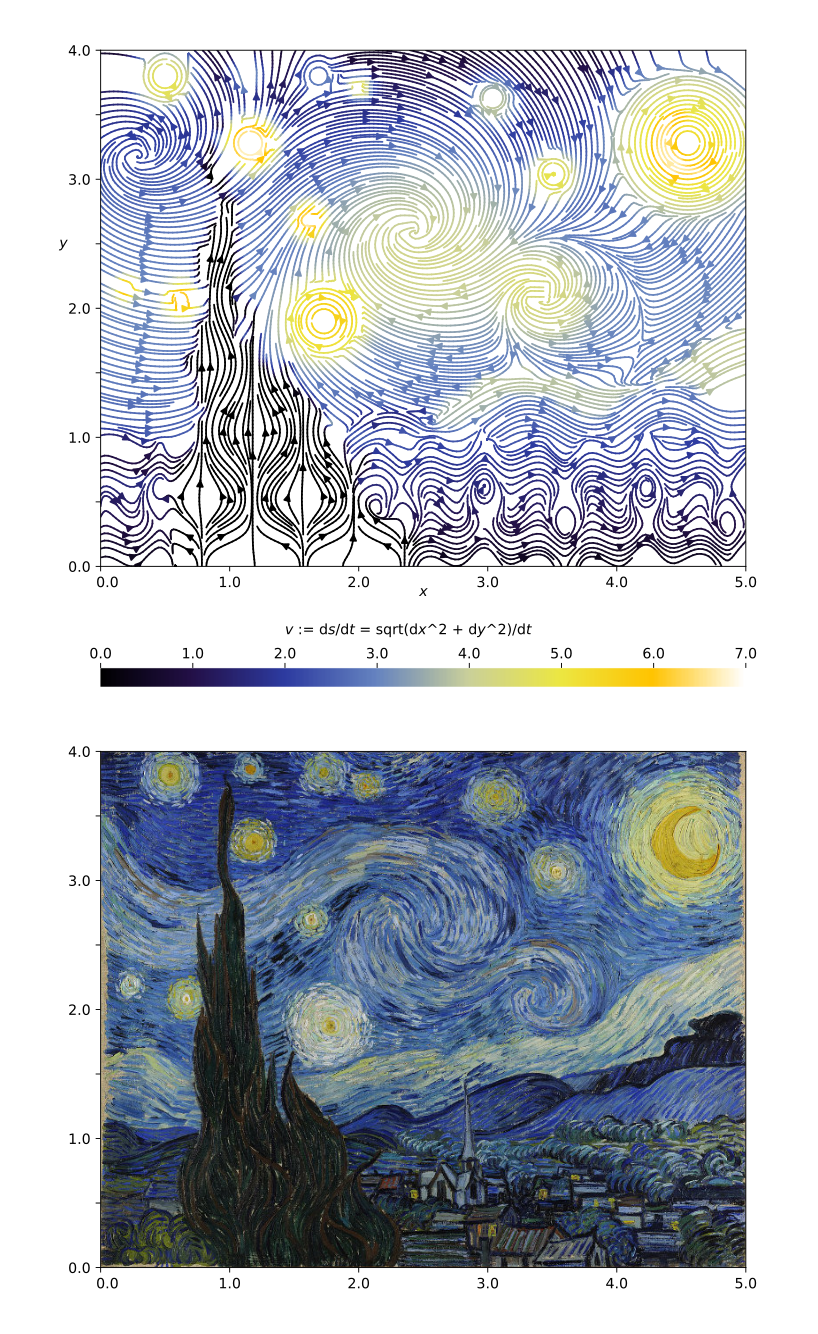
The equations were not written by hand, of course, but generated by linearly combining simpler subsystems in an object oriented manner with Python.
Read moreVisualising the Freudenreich 1998 Model of the Galactic Bar and Disk · PDF
Cosmology summer project in which we reproduced an empirical model of our galaxy’s centre and wrote code to visualise it. Full PDF.
Read more